The Quantum Frontier (Part 1): The Qubit and the Pendulum: Demystifying Quantum Mechanics in Computing
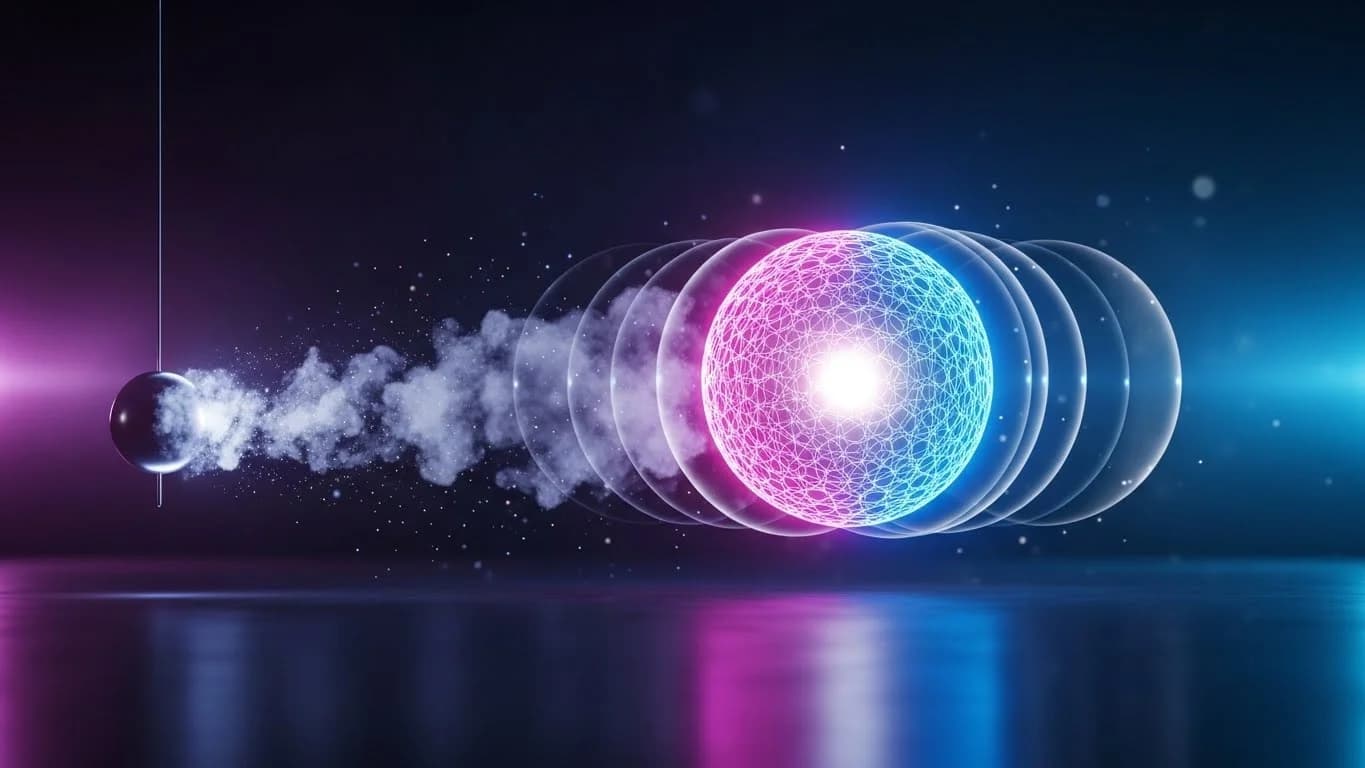
Table of Contents
- The Classical Pendulum: A World of Certainty
- The Quantum Pendulum: A World of Probability
- The Exponential Power of Entanglement
- Conclusion
The Classical Pendulum: A World of Certainty
In our everyday world, things are predictable. A pendulum, when at rest, hangs in exactly one spot: its lowest point. We can call this "0". If we taped it to the top of the clock, it would be at "1". This is the world of classical physics, and it is the world of classical computing. A bit is a simple switch, holding a single, definite value at any given time: 0 or 1.
This binary logic is the foundation of our entire digital lives. But to appreciate why quantum computing represents such a radical departure, it helps to understand just how deeply that foundation runs.
Transistors: The Switches That Built the Modern World
Every classical computer, from the smartphone in your pocket to the largest supercomputer on earth, is built from transistors. A transistor is an electronic switch that can be either on or off, conducting current or blocking it. When a transistor is on, it represents a 1. When it is off, it represents a 0. That is the entirety of its vocabulary.
Modern processors contain billions of these switches. Apple's M-series chips pack upwards of 100 billion transistors onto a single die. Intel and AMD push similar densities. Each transistor is etched at scales measured in nanometers, with leading-edge processes operating at 3nm or below. The pace of miniaturization followed Moore's Law for decades: roughly doubling transistor counts every two years. But we are approaching the physical limits of how small a transistor can be. At atomic scales, quantum effects like electron tunneling begin to cause current leakage, undermining the clean on/off binary that classical computing depends on.
Logic Gates: Combining Switches into Thought
Individual transistors are not particularly useful on their own. Their power emerges when you combine them into logic gates. An AND gate takes two inputs and produces a 1 only if both inputs are 1. An OR gate produces a 1 if either input is 1. A NOT gate flips a 0 to a 1 and vice versa. From these three primitive operations, you can construct every computation a classical computer performs: arithmetic, comparisons, memory access, network routing, graphics rendering, and everything else.
Logic gates are assembled into increasingly complex structures: half adders, full adders, arithmetic logic units, and eventually full processors. The key insight is that no matter how complex the computation, it always reduces to a deterministic sequence of binary operations. Given the same inputs, a classical computer will always produce the same outputs, every single time. There is no ambiguity, no probability, and no uncertainty. The pendulum is always in one position or the other.
The Pendulum Metaphor, Fully Developed
Think of a grandfather clock. The pendulum swings to the left or to the right, and at any frozen moment in time, you can point to its exact position. A classical bit works the same way. You can inspect it and definitively state: this bit is 0, or this bit is 1.
Now imagine you have eight of these pendulums, each independently swinging left or right. Together they represent one byte, a single character of text. The word "hello" requires five bytes, or forty pendulums, each in a definite position. To process information, a classical computer manipulates these pendulums one configuration at a time, stepping through each possible arrangement sequentially if it needs to search or compare.
This sequential nature is both the strength and the limitation of classical computing. It is incredibly reliable. It scales predictably. But for certain categories of problems, notably those involving exponentially large search spaces, combinatorial explosions, or the simulation of quantum-mechanical systems themselves, stepping through possibilities one at a time is hopelessly slow. A classical computer trying to simulate the quantum behavior of a molecule with just 50 interacting particles would need more memory than all the atoms in the observable universe.
This is not a software limitation or an engineering shortfall. It is a fundamental constraint of the computational model. And it is precisely where quantum computing enters the picture.
The Quantum Pendulum: A World of Probability
A quantum computer uses a qubit. A qubit is not a simple switch; it is a quantum object, an electron, an atom, a photon, a superconducting circuit, that follows the laws of quantum mechanics. And at the quantum scale, the rules of the universe are profoundly different from the classical world we experience.
Superposition: Being in Two States at Once
Thanks to superposition, a qubit can exist in a "coherent" state of both 0 and 1 at the same time, and every possible state in between. This is not a metaphor or an approximation. It is a physical reality, confirmed by nearly a century of experimental physics.
Returning to our pendulum metaphor: imagine a pendulum that, instead of being frozen at left or right, exists as a blur of all possible positions simultaneously. It is not that we do not know where it is. It genuinely occupies a probabilistic combination of positions until the moment we look at it.
Mathematically, the state of a qubit is described as a linear combination of its two basis states. If we label these basis states |0> and |1>, then a qubit's state can be written as alpha|0> + beta|1>, where alpha and beta are complex numbers called probability amplitudes. The constraint is that the squared magnitudes of alpha and beta must sum to 1, since they represent probabilities. When alpha equals 1, the qubit is definitely in state |0>. When beta equals 1, it is definitely in state |1>. But for any other combination, the qubit genuinely exists in both states simultaneously.
The Bloch Sphere: Visualizing the Qubit
Physicists visualize a qubit's state using the Bloch sphere, a unit sphere where the north pole represents |0>, the south pole represents |1>, and every other point on the surface represents a valid superposition. The equator represents states with equal probability of measuring 0 or 1, but with different phases. Phase is a critical concept: it is the relative relationship between the alpha and beta amplitudes, and it is what allows quantum algorithms to work through constructive and destructive interference.
A classical bit can only be at the north or south pole. A qubit can be anywhere on the entire surface of the sphere. This is a fundamentally richer representation of information.
Measurement and Wave Function Collapse
Here is the catch, and it is the feature that makes quantum computing both powerful and deeply counterintuitive. When you measure a qubit, its superposition collapses. The blur resolves into a definite outcome: either 0 or 1, with probabilities determined by those amplitudes alpha and beta. If the qubit's state is (0.6)|0> + (0.8)|1>, you have a 36% chance of measuring 0 and a 64% chance of measuring 1.
After measurement, the qubit is in whatever state you measured. The superposition is destroyed. You cannot go back. This means you cannot simply "read out" all the information a qubit holds in superposition. Quantum algorithms must be carefully designed to manipulate probability amplitudes so that, when measurement finally occurs, the correct answer has been amplified to high probability and incorrect answers have been suppressed through destructive interference.
This is the art of quantum algorithm design: choreographing interference patterns so that the useful information survives measurement and the noise cancels itself out.
Quantum Gates: Manipulating the Pendulum
Just as classical computers use logic gates to manipulate bits, quantum computers use quantum gates to manipulate qubits. A Hadamard gate, for example, takes a qubit in state |0> and puts it into an equal superposition of |0> and |1>. A Pauli-X gate flips |0> to |1> and vice versa, analogous to a classical NOT gate. A CNOT (controlled-NOT) gate entangles two qubits, flipping the second qubit's state only if the first qubit is |1>.
The critical difference from classical gates is that quantum gates are reversible. Every quantum operation can be undone. This reversibility, combined with superposition and entanglement, gives quantum circuits their unique computational character.
The Exponential Power of Entanglement
Superposition alone, while remarkable, does not fully explain quantum computing's potential. The real power emerges when qubits become entangled.
EPR Pairs and Bell States
Entanglement is a quantum phenomenon where two or more qubits become correlated in such a way that the state of one cannot be described independently of the others. The concept was first explored in a famous 1935 thought experiment by Einstein, Podolsky, and Rosen (the EPR paradox), who argued that entanglement implied quantum mechanics was incomplete. Einstein famously called it "spooky action at a distance."
Decades of experiments, culminating in the 2022 Nobel Prize in Physics awarded to Alain Aspect, John Clauser, and Anton Zeilinger, have definitively proven that entanglement is real. Bell's theorem and the experimental violation of Bell inequalities showed that no theory of local hidden variables can reproduce quantum mechanical predictions.
The simplest entangled state is a Bell state, created by applying a Hadamard gate to one qubit followed by a CNOT gate targeting a second qubit. The result is a two-qubit system where measuring one qubit instantly determines the state of the other, regardless of the physical distance between them. If you measure the first qubit and find it is |0>, the second qubit will also be |0>. If you find |1>, the second qubit is also |1>. These correlations are stronger than anything classical physics allows.
The Exponential State Space
Entanglement is what transforms quantum computing from merely interesting to genuinely revolutionary. Consider the scaling:
- 1 classical bit stores 1 value (0 or 1). 1 qubit in superposition represents 2 values simultaneously.
- 2 classical bits store 1 of 4 possible combinations. 2 entangled qubits represent all 4 combinations simultaneously.
- 10 classical bits store 1 of 1,024 combinations. 10 entangled qubits represent all 1,024 simultaneously.
- 50 entangled qubits represent 2^50, over one quadrillion, states simultaneously.
- 300 entangled qubits represent 2^300 states, a number that exceeds the estimated number of particles in the observable universe.
This exponential scaling, 2^N states for N entangled qubits, is the source of quantum computing's power. A quantum computer with a few hundred high-quality, fully entangled qubits operates in a state space that no classical computer, no matter how large, could ever represent in full.
Why This Matters for Computing
It is important to be precise about what this means. Quantum computers are not simply "faster classical computers." They are not going to make your web browser load pages more quickly or speed up your spreadsheet calculations. For the vast majority of everyday computing tasks, classical computers are already optimal and will remain so for the foreseeable future. Sending an email, rendering a web page, training a standard neural network: these are all tasks where classical architectures excel, and quantum computers offer no meaningful advantage.
Where quantum computers excel is in problems whose structure maps naturally onto quantum mechanics. Simulating quantum systems (chemistry, materials science) is the most obvious example, since you are using quantum hardware to model quantum phenomena. Certain optimization problems benefit because quantum superposition can explore many candidate solutions in parallel. Cryptographic problems like integer factorization are vulnerable because Shor's algorithm exploits the quantum Fourier transform to find hidden periodicities exponentially faster than any known classical method.
For a concrete comparison: factoring a 2,048-bit RSA key would take a classical supercomputer longer than the age of the universe. A sufficiently large, fault-tolerant quantum computer could accomplish it in hours. Simulating the electronic structure of a moderately complex molecule like caffeine (with 24 heavy atoms) is intractable on classical hardware using exact methods. A future quantum computer with a few thousand logical qubits could handle it directly.
The pendulum metaphor comes full circle here. Classical computing gives us a world of definite positions, one state at a time, stepping through possibilities sequentially. Quantum computing gives us a world of simultaneous possibilities, exploring vast landscapes in parallel, collapsing to a definite answer only at the moment of measurement.
Conclusion
Quantum computers operate in a realm of probability, not certainty. Through superposition, a single qubit encodes richer information than a classical bit. Through entanglement, multiple qubits create an exponentially large state space that no classical system can replicate. Through carefully designed interference, quantum algorithms amplify correct answers and suppress incorrect ones.
This unique computational model does not replace classical computing. It complements it, opening doors to problems that were previously beyond reach: breaking cryptographic codes, simulating molecular interactions, optimizing complex systems with billions of variables. The implications for cybersecurity, medicine, materials science, finance, and artificial intelligence are profound.
In the next installment of this series, we will explore the most immediate and urgent of these implications: how Shor's algorithm threatens to unravel the cryptographic foundations of our digital world, and why cybersecurity leaders need to be paying attention right now.
At the beginning
Read Next →
Keep Exploring