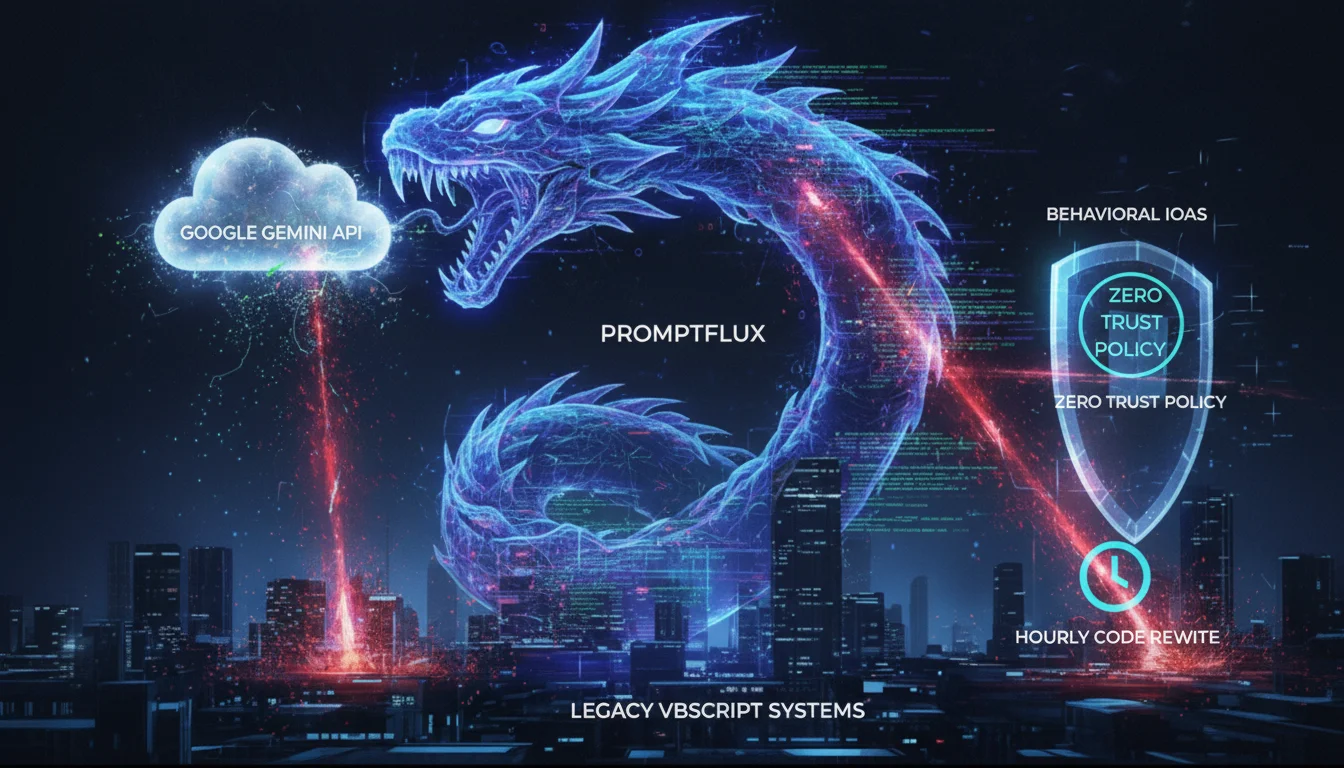
Signature-based detection rests on a single assumption: that malware looks the same from one infection to the next, so a fingerprint taken once will match copies seen later. PROMPTFLUX is built specifically to break that assumption. It carries a prompt and calls out to a generative model to rewrite its own source on an interval, producing a fresh, functionally identical, structurally unique variant every cycle.
How It Works
The mechanism is conceptually simple and operationally nasty:
- A regeneration loop. On a schedule, the malware sends its own code to an LLM with an instruction to rewrite it while preserving behavior.
- Functional invariance, structural novelty. The rewritten code does the same thing through different control flow, different variable names, different structure, so it does the same damage while presenting a different fingerprint.
- Living off a legitimate API. Because the heavy lifting happens at a normal AI provider endpoint, the outbound traffic blends into the now-ubiquitous noise of legitimate AI usage.
Why It Defeats Signatures
A signature is a hash or pattern of known-bad code. PROMPTFLUX guarantees that the code is never the same twice, so the signature taken from one sample never matches the next. The detection model that has served the industry for thirty years assumes a static target. This target rewrites itself faster than signatures can be distributed.
What Actually Stops It
The defenses that work do not care what the code looks like. They care what it does:
- Behavioral detection. Watch for the actions: process injection, persistence, suspicious egress: regardless of how the code is structured.
- Egress monitoring. A regeneration loop must periodically reach an external model. Anomalous outbound patterns are a detectable tell even when the payload is novel.
- Least privilege and isolation. Malware that cannot reach sensitive systems cannot harm them, however cleverly it rewrites itself.
- AI-usage governance. As legitimate AI traffic becomes the cover, governing and logging that traffic becomes a security control, not just a compliance one.
The Read
PROMPTFLUX is a preview, not an anomaly. Generative models lower the cost of polymorphism to near zero, and the industry's signature-based muscle memory is the wrong tool for an adversary that changes shape on a timer. The shift this forces, from recognizing known-bad artifacts to recognizing bad behavior, is overdue regardless. PROMPTFLUX just makes it non-optional.