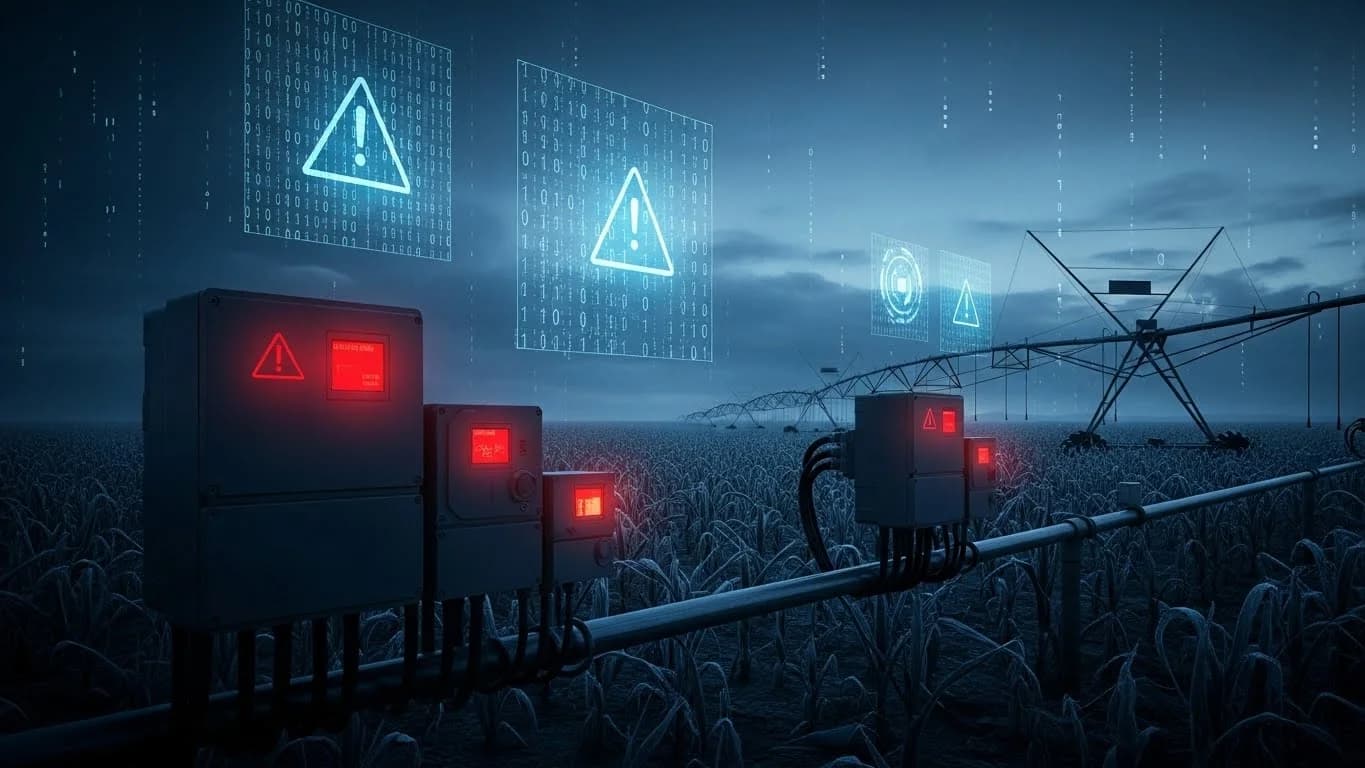
The Babel of the Soil: The Engineering Challenge of Mixed-Fleet Autonomy
Table of Contents
- The Phase Transition
- The Physical Layer Bottleneck: Why ISOBUS Cannot See
- The Cloud Layer: Read-Only APIs and Walled Gardens
- The Hack Solution: Retrofit Autonomy
- Solving the Syntax: The ADAPT Framework
- Solving the Semantics: DEMETER and Ontologies
- Conclusion
The Phase Transition
The global agricultural sector is undergoing a phase transition. We are moving from the era of Precision Agriculture—defined by GPS guidance and variable rate control—to the era of Autonomy, defined by perception systems, path planning, and edge computing.
However, as we deploy autonomous agents into the field, we are hitting a hard wall: Interoperability.
In a real-world "mixed fleet" operation, a farmer might run a John Deere 8R for planting, a Fendt Ideal combine for harvest, and a swarm of retrofitted Kubotas for spraying. For these machines to operate as a coordinated swarm, they need to share more than just GPS coordinates; they need to share intent, perception data, and task states.
Currently, they cannot.
This post dissects the technical "Tower of Babel" preventing true mixed-fleet autonomy, ranging from the physical bandwidth limits of the 1990s-era CAN bus to the semantic fragmentation of modern cloud APIs.
The Physical Layer Bottleneck: Why ISOBUS Cannot See
The nervous system of modern agricultural machinery is ISO 11783, commonly known as ISOBUS. Based on the SAE J1939 protocol (which itself sits on top of the CAN 2.0B physical layer), ISOBUS was a triumph of standardization when it was conceived in the early 1990s. It allowed a display from Manufacturer A to control an implement from Manufacturer B.
But ISOBUS was designed for control signals ("Open Valve A", "Engine RPM: 2000"), not perception data. The standard ISOBUS implementation is capped at a baud rate of 250 kbit/s.
The Bandwidth Gap
Consider the data requirements of a modern autonomous safety stack:
| Data Source | Bandwidth Requirement |
|---|---|
| ISOBUS Capacity | ~0.25 Mbit/s |
| Single IP Camera (1080p) | ~10 Mbit/s |
| LiDAR Point Cloud | ~20–50 Mbit/s |
A single vision sensor generates orders of magnitude more data than the entire tractor's network can handle. This forces autonomous retrofitters (like Blue White Robotics or Sabanto) to bypass the tractor's native infrastructure entirely, adding redundant wiring harnesses, modems, and displays into the cab.
The Ethernet Horizon
The industry's answer is High-Speed ISOBUS (HSI), currently being standardized by the Agricultural Industry Electronics Foundation (AEF). HSI utilizes 1000BASE-T1 Automotive Ethernet, jumping from 250 kbit/s to 1 Gbit/s.
However, until HSI is ubiquitous (which will take a decade of fleet turnover), mixed fleets will remain physically fragmented, requiring gateways to bridge the gap between high-speed autonomous sensors and low-speed tractor actuators.
The Cloud Layer: Read-Only APIs and Walled Gardens
If the physical layer is a narrow pipe, the cloud layer is a locked door. For a mixed fleet to function, a central "Mission Control" system needs to orchestrate machines from different OEMs.
In 2019, major OEMs (John Deere, Claas, CNH Industrial) launched DataConnect, a direct cloud-to-cloud bridge. While a diplomatic milestone, technically, it is a read-only solution restricted to five basic parameters:
| Parameter | Description |
|---|---|
| Location (Current & History) | GPS coordinates and track logs |
| Speed | Ground speed of the machine |
| Fuel Level | Tank percentage |
| Working Status | Active/Idle state |
| Heading | Directional bearing |
DataConnect does not support the exchange of Task Data (e.g., path plans) or Perception Data (e.g., obstacle maps). You can see where your mixed fleet is, but you cannot command it.
API Rate Limiting and Developer Friction
Developers attempting to build third-party orchestration layers face aggressive API rate limiting. For instance, the John Deere Operations Center API utilizes pagination limits (e.g., 100 records per call), forcing developers to implement complex polling architectures rather than true event-driven control loops.
This architectural friction is not accidental. OEMs have strong incentives to keep customers within their ecosystems. The data flowing off these machines—yield maps, soil conductivity, prescription zones—is enormously valuable. Opening APIs for full control would enable competitors to commoditize the hardware layer.
The Hack Solution: Retrofit Autonomy
Because the standard interfaces (ISOBUS and Cloud APIs) are insufficient for autonomy, startups have turned to retrofitting. This involves taking a "dumb" tractor and clamping on an autonomous brain.
There are two primary engineering approaches:
Mechanical Actuation
This approach uses robots that physically turn the steering wheel and press pedals. Companies like Monarch Tractor and Bear Flag Robotics (now John Deere) have employed variants of this approach.
Advantages:
- Universally compatible with any vehicle
- No reverse engineering required
- Preserves manufacturer warranty
Disadvantages:
- Lacks deep vehicle feedback
- Slower response times
- Additional mechanical failure points
Drive-by-Wire (CAN Injection)
This approach involves reverse-engineering the proprietary J1939 CAN messages to inject steering and throttle commands directly onto the bus.
Advantages:
- Native integration with vehicle systems
- Fast response times
- Access to vehicle telemetry
Disadvantages:
- Requires per-model reverse engineering
- May void warranty
- Creates security attack vectors
The Security Paradox
Opening up the CAN bus for retrofits introduces massive security vulnerabilities. At DEF CON 2022, security researcher Sick Codes demonstrated a jailbreak of a John Deere 4640 display, eventually running the game Doom on it.
The exploit chain involved physical access to the board and utilizing unpatched vulnerabilities in the underlying Linux/Windows CE environments. For a mixed fleet, this highlights a critical risk: every third-party retrofit kit is a potential new attack vector into the tractor's secure control network.
| Attack Vector | Risk Level | Mitigation |
|---|---|---|
| CAN message injection | Critical | Message authentication, anomaly detection |
| Firmware tampering | High | Secure boot, code signing |
| Credential theft | High | Hardware security modules |
| Network bridging | Critical | Air-gapped OT networks |
The industry faces an uncomfortable tradeoff: the same openness that enables interoperability also enables exploitation.
Solving the Syntax: The ADAPT Framework
To solve the data fragmentation problem—where every manufacturer uses a different file format (CN1, GS3, ISOXML)—the industry is rallying around AgGateway's ADAPT (Agricultural Data Application Programming Toolkit).
ADAPT is an open-source middleware that acts as a "Universal Translator." It uses a plugin architecture to convert proprietary data into a Common Object Model.
How ADAPT Works
┌─────────────────┐     ┌─────────────────┐     ┌─────────────────┐
│   Proprietary   │     │     ADAPT       │     │      FMIS       │
│   Data Format   │ ──▶ │  Plugin Layer   │ ──▶ │   Application   │
│  (CN1, ISOXML)  │     │                 │     │                 │
└─────────────────┘     └─────────────────┘     └─────────────────┘
         │                      │                       │
         ▼                      ▼                       ▼
    Manufacturer           Common Object            Normalized
    Specific Binary          Model                  Consumption
1. Plugin Layer: Manufacturers write a plugin (e.g., the CNH Plugin or GreenStar Plugin) that knows how to read their specific binary format.
2. Normalization: The plugin hydrates the ADAPT Common Object Model, mapping proprietary fields to standard objects (e.g., LogData to WorkRecord).
3. Consumption: The FMIS (Farm Management Information System) consumes the clean, normalized object, unaware of the original source format.
The Limitations of Syntactic Translation
ADAPT solves file format interoperability, but it does not solve real-time control interoperability. It is designed for post-hoc data aggregation—pulling yield maps from different machines into a single dashboard—not for commanding a mixed fleet in real-time.
For autonomous swarm coordination, we need something more: semantic interoperability.
Solving the Semantics: DEMETER and Ontologies
ADAPT solves the syntax (file formats), but we still have a semantic problem. If one robot reports "Yield" in bushels/acre and another in kg/hectare, or if one sensor defines "moisture" as soil VWC and another as leaf wetness, the swarm fails.
Projects like DEMETER (funded by the EU Horizon 2020 program) are addressing this by building the Agriculture Information Model (AIM). AIM is an ontology—a formal, machine-readable description of concepts and their relationships.
What Is an Ontology?
An ontology goes beyond data schemas. It defines:
- Classes: What types of things exist (Sensor, Observation, Field, Crop)
- Properties: What attributes those things have (hasLocation, measures, belongsTo)
- Relationships: How things relate to each other (Sensor observes Property of Field)
- Constraints: What combinations are valid (a SoilMoistureSensor cannot measure AirTemperature)
The W3C SOSA Standard
AIM links agricultural data to established semantic standards like W3C SOSA (Sensor, Observation, Sample, and Actuator). SOSA provides a vocabulary for describing sensor networks that is domain-agnostic but extensible.
# Example: A soil moisture observation in SOSA/SSN
ex:observation1 a sosa:Observation ;
    sosa:hasFeatureOfInterest ex:field_zone_A ;
    sosa:observedProperty ex:SoilVolumetricWaterContent ;
    sosa:hasResult [
        qudt:numericValue 0.32 ;
        qudt:unit unit:M3-PER-M3 ;
    ] ;
    sosa:resultTime "2025-12-26T14:30:00Z"^^xsd:dateTime ;
    sosa:madeBySensor ex:sensor_node_42 .
By using ontologies, a mixed fleet can achieve Semantic Interoperability—a John Deere sprayer can understand a "Weed Detected" message from a DJI drone without human translation. The ontology provides the shared vocabulary and the inference rules to bridge manufacturer-specific terminology.
The Path to Semantic Swarms
| Interoperability Level | Solution | Status |
|---|---|---|
| Physical (wiring) | ISOBUS → HSI | In transition |
| Syntactic (file formats) | ADAPT | Mature |
| Semantic (meaning) | AIM/SOSA | Emerging |
| Pragmatic (intent) | Standardized task languages | Research stage |
True autonomous swarm coordination will require all four levels. We are currently strongest at the syntactic level (thanks to ADAPT) and weakest at the pragmatic level—defining a common language for expressing tasks like "follow machine A at 10m offset" or "spray detected weeds with prescription B."
Conclusion
The future of agriculture is not a single-brand monopoly; it is a heterogeneous, interoperable swarm. Achieving this requires:
- Moving beyond the 250 kbit/s limits of ISOBUS to Gigabit Ethernet through HSI standardization and fleet turnover
- Moving from closed APIs to open ontologies like AIM that enable semantic understanding across manufacturers
- Acknowledging that "Right to Repair" also means "Right to Interoperate" as a policy position
The security implications cannot be ignored. Every interface opened for interoperability is a potential attack surface. The agricultural sector must learn from the hard lessons of industrial control system security—segmentation, authentication, and anomaly detection—before the first coordinated cyber-attack on an autonomous fleet.
Until these standards mature, the burden remains on the engineering community to build the bridges—the gateways, plugins, and retrofits—that let the machines talk.
The Tower of Babel was not solved by a better tower. It was solved by a common language. Agriculture needs its Rosetta Stone.
#agriculture #autonomy #IoT #precisionAgriculture #interoperability #ISOBUS #CANbus #robotics #edgeComputing #OTSecurity #standards #agTech